As part of my Family History Research Diploma with the University of Tasmania, I recently completed the Writing Family History unit (HAA004). One of the amazing things I learned as part of that unit was different ways to take an ancestor’s story and turn it into fiction.
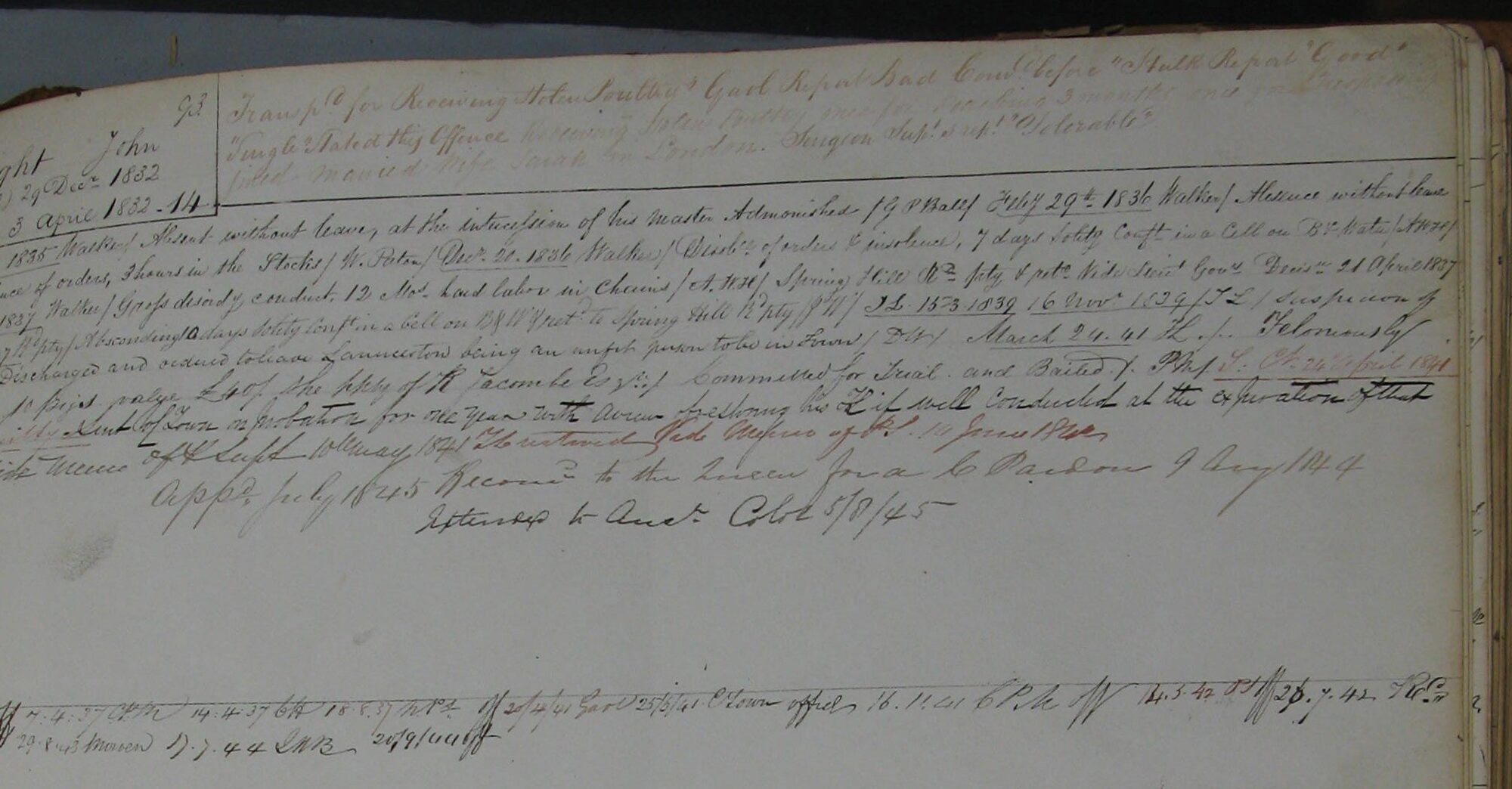
For my assignment, I chose John Dight – a first cousin five times removed who arrived here as a convict. The more I learned about him, the more I wanted to learn! But writing about him was a challenge – until I tried the fiction method.
I found the non-fiction method resulted in a list of details that referred to all the wonderful records, but didn’t give me the room to speculate about his personality, his motivations, or the gaps in the records. When I began trying to hear his voice in my head, having him explain himself to me – a person living in the 21st Century – that was when he came to life. And that convinced me to write about him from the first-person point of view. However, I then had to decide how much of an 1830s Somerset voice to give him. As this is for the modern reader, I figured ‘less is more’.
There were at least two other John Dights in early colonial Australia (see the last two references in the Bibliography below), both of whom were on the ‘good’ side of society – hence the title ‘The Other John Dight’.
This is only a short piece based on the early part of his life, but with more research (and effort, lol) I’d love to turn it into a novella one day. If that happens, I’ll let you know! But for now, here’s John’s story, in his own words – as I heard them in my head. 😉
~ ~ ~
It’s funny how you can look back on your life and consider that perhaps some of the shite things you went through actually helped you be a better person. I mean, it’d be easy to blame brother Billy for leading me astray in the first place. Let’s face it, 14’s a pretty young age to be nabbed by the law for the first time, and I didn’t have to keep going down that path. Yet I did. I can make excuses, and I did make excuses! But I reckon I ended up in a better place. And maybe a better person for it. You’d have to ask the missus about that one, though.
I don’t blame Billy, it’s just the way things were. Our parents tried, but it were hard for Pa to get work, and even though Billy and I were labouring, too, we weren’t getting much work, either. And yes, I were working at 14 – we didn’t have school the way you know it today!
So one night me and Billy were on our way home and he says to me he knows a shop in Milverton where we can nick some ham after dark. One of his mates worked there and told Billy he’d leave the back door unlocked for us, but we could only take one piece – it needed to be the owner wouldn’t notice for a day or two. Well, bugger me if the owner not only noticed the missing ham first thing next day, but belted Billy’s mate for leaving the door unlocked – and belted him again until he told him who stole it!
And that’s how we ended up in Wilton Gaol for a week. At least we got fed every day, even if the food were shite. That were in 1823.
Anyways, after that, Billy kept his nose clean as much as he could, and I pretty much did the same, except when we were really starving. But we didn’t do anything together after that – parents couldn’t cope with us both going back to gaol at the same time.
Then Billy met Susan and they got married in ’28, so she kept ’im on the straight and narrow. But I got done again in ’29 and the blasted judge gave me three months this time!
I met a couple of lads inside – Henry and Mark – who were doing time for stealing, too. I told ’em I’d decided that were it – no more. Well, no more stealing, that is. I figured I’d pay for what someone else stole, then sell it at a profit.
‘I think we can do business together, then,’ Henry suggested quietly over supper one night, with one eye on the warder. ‘If you can pay upfront for anything we can deliver, we’ll supply. Whaddya sell?’
‘Me? Meat – mostly poultry. I’ve had a job with a poulterer the last couple o’ years. Going to set up on me own when I get out – he won’t have me back.’
‘Done!’ jumped in Mark, a bit too keen and loud. Strong glares from me, Henry and the warder quickly quietened him down. ‘Looking forward to doing business wiv ya, Johnny,’ he whispered.
‘We’re due out in November, so it looks like we’ll have a good Christmas – if we can get enough turkeys to yer!’ said Henry, sealing our business deal.
‘Don’t know that me clients will be posh enough to be wantin’ turkeys, Henry – perhaps some ducks? Or chickens? Not too big to carry, and not too much to cost!’
~ ~ ~
Christmas that year were probably one of the best ones ever. Mark and Henry were sharp and quick – sourcing and delivering just enough poultry to keep me new customers happy. I could sell ’em cheap because I worked door-to-door, word of mouth, no overheads.
We had busy periods like Easter and Christmas, then more relaxed periods in-between. I kept a box under me bed with me profits in, and it felt good to help Ma and Pa out a bit.
All went well for a year or two, but good things never last and the lads got nabbed in February of ’32. We all ended up in court in the April, with Mark and Henry accused of stealing seven ducks, three drakes and 13 fowl, and me accused of receiving.
I had me say and told the court that we had a business deal, that because I were a poulterer, I’d keep their new stock overnight until they could get ’em to their clients. But the judge didn’t buy it. The lads said I were the ‘mastermind’ – never been so flattered in me life, mind – and so they got seven years’ transportation each for stealing, but I got 14 just for receiving!
I don’t remember much after hearin’ that, but they say I took a fit, dropped to the floor and it took eight men to hold me down. When I come round, they said for me to be taken to the Hardy – one of them prison hulks – where I’d wait out me time until they took me to Van Diemen’s Land. Weren’t that a rough three months!
So when they put me on the York for Van Diemen’s, it were no gentlemen’s ship, but it were still a better trip than we’d have had on the Hardy. Except when the seas were rough – then it were no fun for any of us, better boat or not!
Took us four months to get here and it were weird leaving Portsmouth in late summer and arriving in Hobart Town in early summer. I weren’t used to it being sunny in December! And it were weird seeing the land here, too: green and rolling – like Somerset, but not. The buildings were sort of the same, what there were of ’em, but being mostly convict built they weren’t as classy as back home. But they were all cleaner than in Taunton, say. Not enough people, not enough houses, so not enough smoke to make the stone black!
And that were one thing I loved about coming here – the fresh air. Between the sea breeze and the native plants and trees – it were like nothing I could have imagined.
If this were going to be my prison for the next 14 years, I’d cop it!
~ ~ ~
Bibliography
Ancestry.com, Australian Convict Transportation Registers – Other Fleets & Ships, 1791-1868, accessed 26 June 2026.
Ancestry.com, England & Wales, Criminal Registers, 1791-1892, accessed 22 June 2026.
Ancestry.com, Somerset, England, Marriage Registers, Bonds and Allegations, 1754-1924, accessed 27 Jun 2026.
Ancestry.com, Somerset, England, Gaol Registers, 1807-1879, accessed 27 Jun 2026.
Ancestry.com, UK, Prison Hulk Registers and Letter Books, 1802-1849, accessed 26 June 2026.
Newspapers.com, Jackson’s Oxford Journal, Oxford, Oxfordshire, England,
7 April 1832, ‘Berkshire Easter Sessions’, p.3, accessed 26 June 2026.
People Australia, ‘Dight, John (1772–1837), surgeon and farmer’, People Australia website, n.d., https://peopleaustralia.anu.edu.au/biography/dight-john-17588, accessed 9 September 2026.
People Australia, ‘Dight, John (1808–1867) pastoralist and millwright’, People Australia website, n.d., https://peopleaustralia.anu.edu.au/biography/dight-john-17593 accessed 9 September 2026.
View other records at:
https://foundersandsurvivors.org/pubsearch/convict/chain/c31a31100216 – Founders and Survivors summary of John Dight and his convict record
https://libraries.tas.gov.au/Digital/CON31-1-10/CON31-1-10P96 – Libraries of Tasmania image of John Dight’s convict record