As we are all currently aware, the world is an ever-changing place and conflict is often not far from any of our doors, depending on the decade, what’s happening, and where. What comes next in this post is not meant to form any sort of commentary on international affairs, but simply to share some amazing photos and documents from another time and place in the world.
Following World War 2, the UK Ministry of Works (MoW) engaged staff to travel to Iran to work on the Iranian Roads Reconstruction Project. My dad, Hugh Butler, was one of those people and, from the stories I recall, he had an interesting and enjoyable time there. He was always one who was intrigued by other cultures – how people lived, where they lived, what they believed in, the languages they spoke, how they were different to him – so I can imagine him jumping at the chance.
Leaving England for Iran, post-war
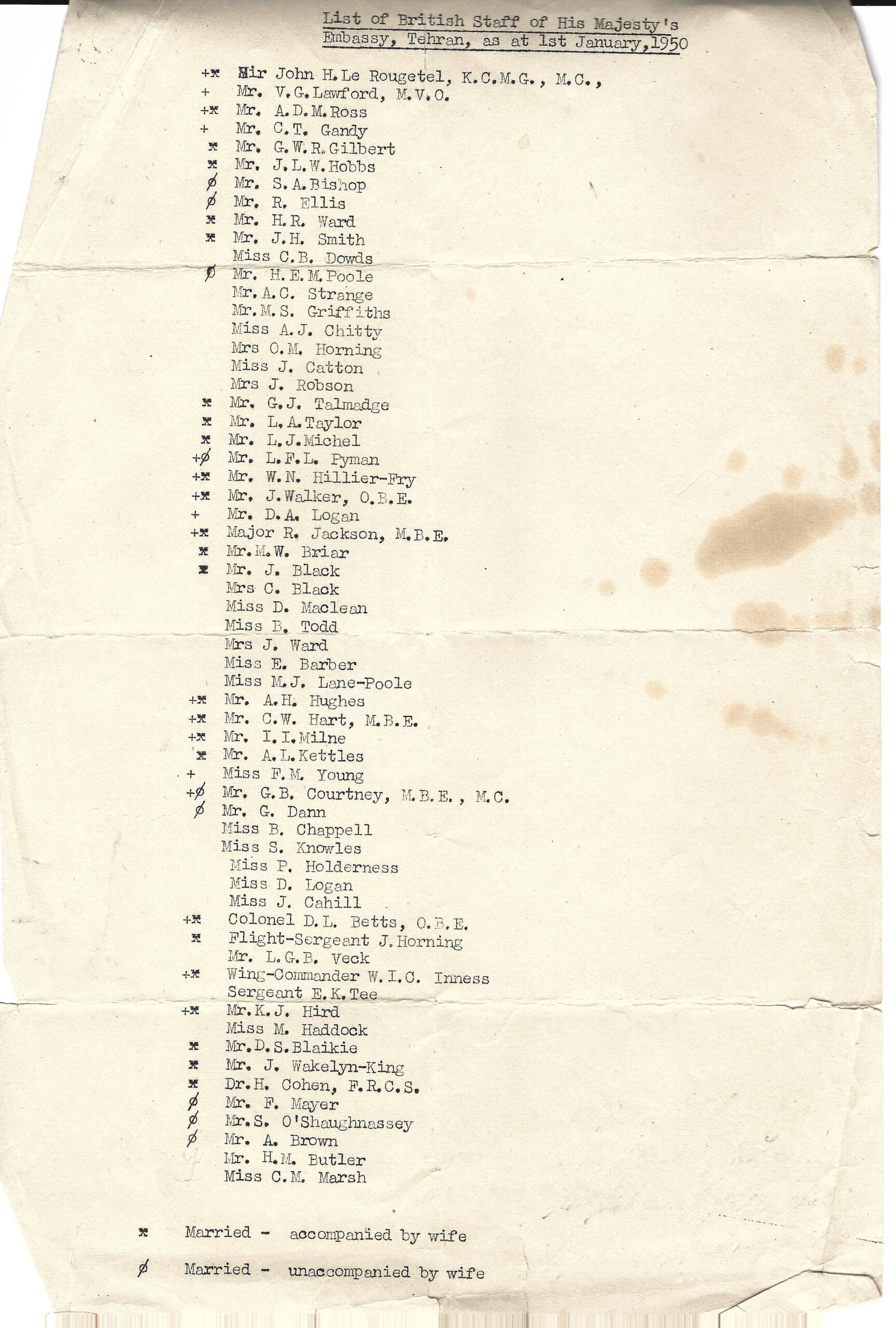
Going through some of Dad’s documents and photos, I found that he was booked on a BOAC (British Overseas Airways Corporation) flight from London to Cairo, arriving at 9.05 am on 29 September 1949. He was allowed 30 kilos of free baggage – pretty good for those days! I’m not sure what happened after he landed in Cairo, but by the end of 1949 he, along with a whole host of other Brits, was in Tehran, Iran, as per this list of British Embassy Staff as at 1 January 1950:
Click here for a transcription of the above list
Note that Dad is second last on the list. He was obviously not the most important person in the project! 😉
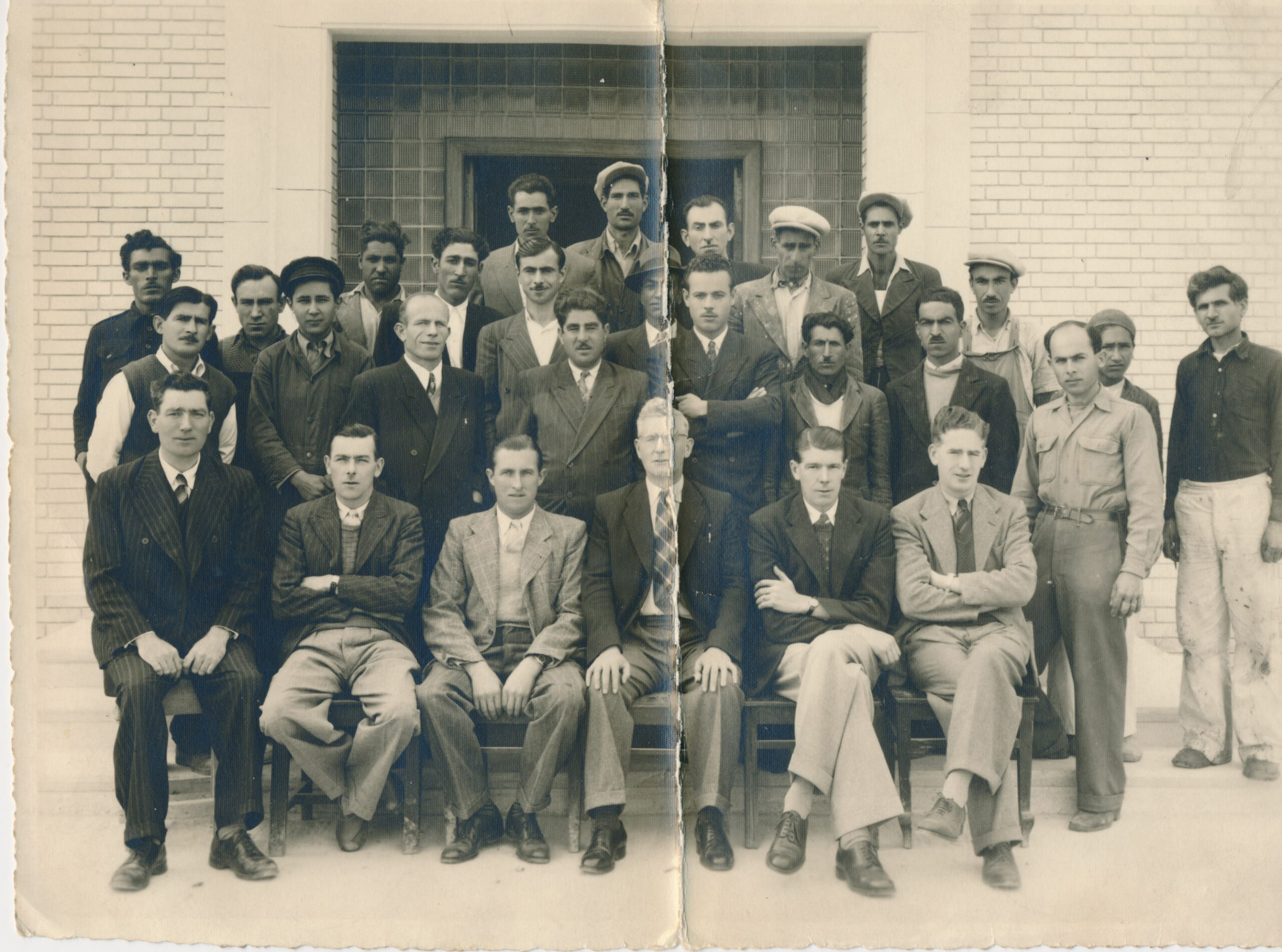
Some of the people from the above list are probably in this photo of Ministry of Works staff below, but of course the only one I know is Dad. He’s in the front row, bottom right, with his arms folded and legs crossed, same as the fellow to his right!
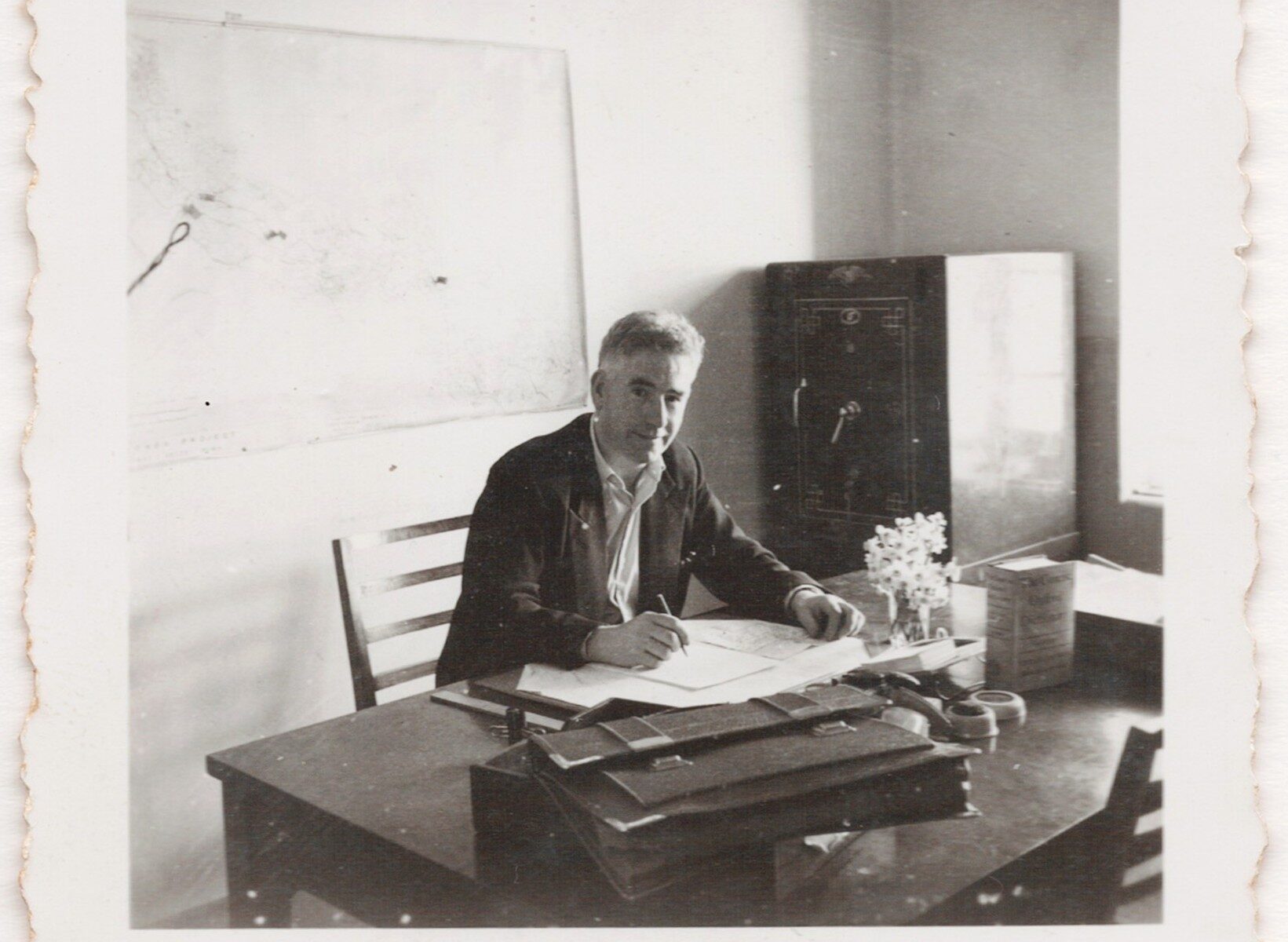
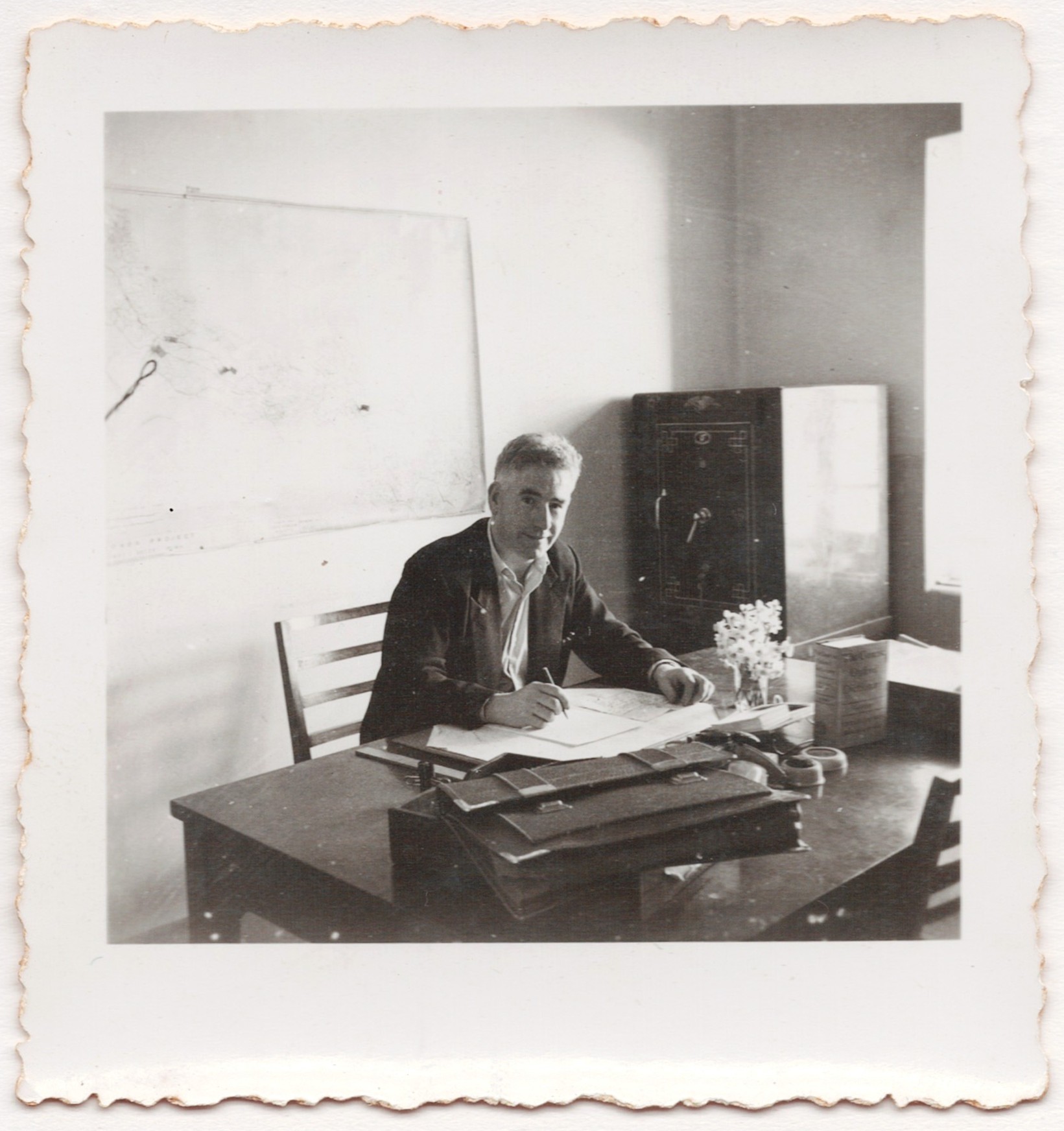
I know Dad worked hard judging by the references he retained, but also by this next photo of him at his desk in Tehran. I love that he has a bunch of flowers on his desk (they look like jonquils when I zoom in on my scanned version), along with a copy of the Concise Oxford Dictionary (standing up just in front of the flowers).
The edges of the photo also amaze me – see how it’s been cut with a pattern applied to the edges? I do have a few pairs of scissors in my art cupboard which will cut patterns into paper like that, but I didn’t know that they had a similar tool 75 years ago!
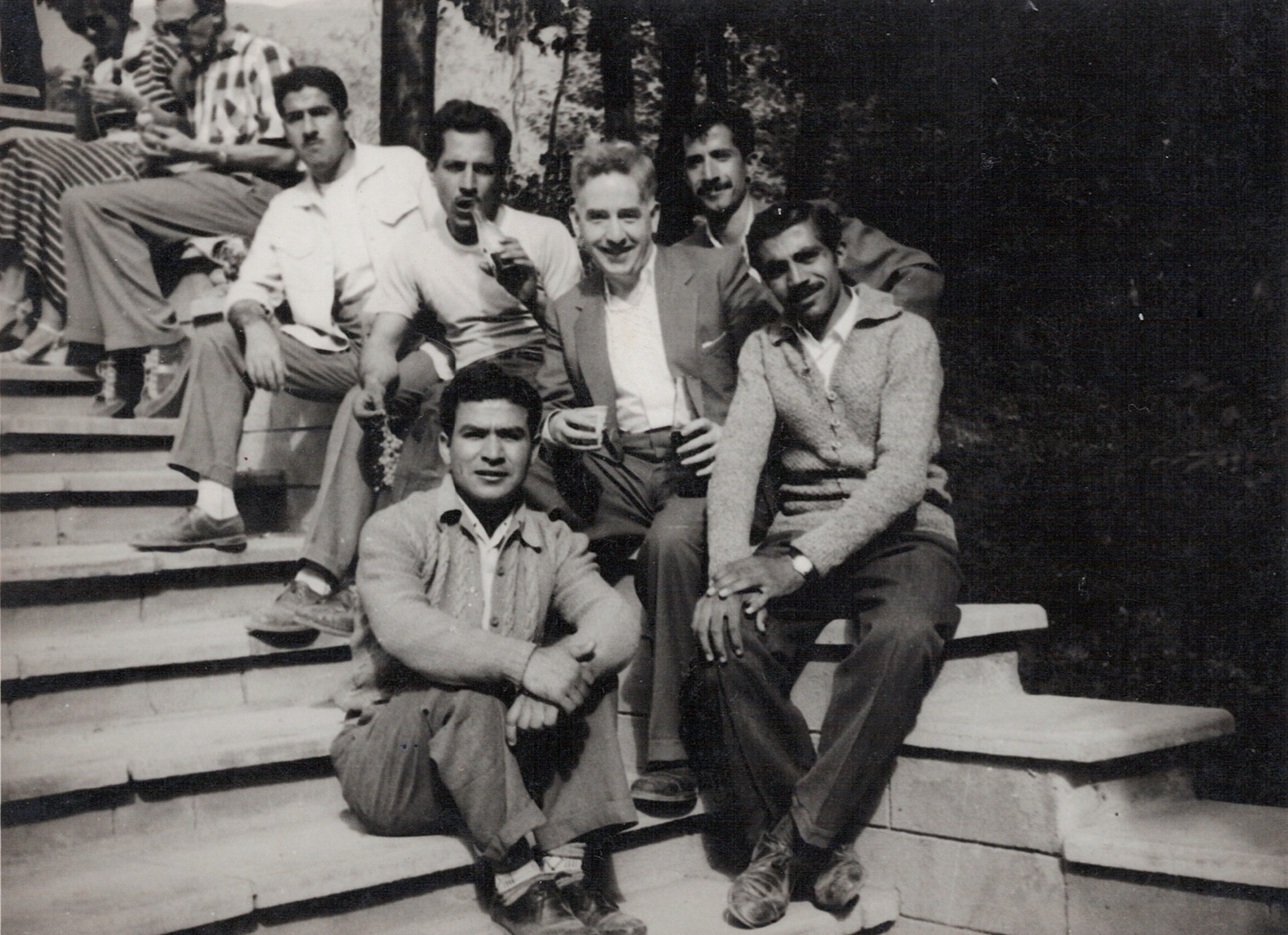
While I’m sure he worked hard, Dad also seems to have found time to relax. Here he is firstly with staff of the Planning and Organising Highways Section:
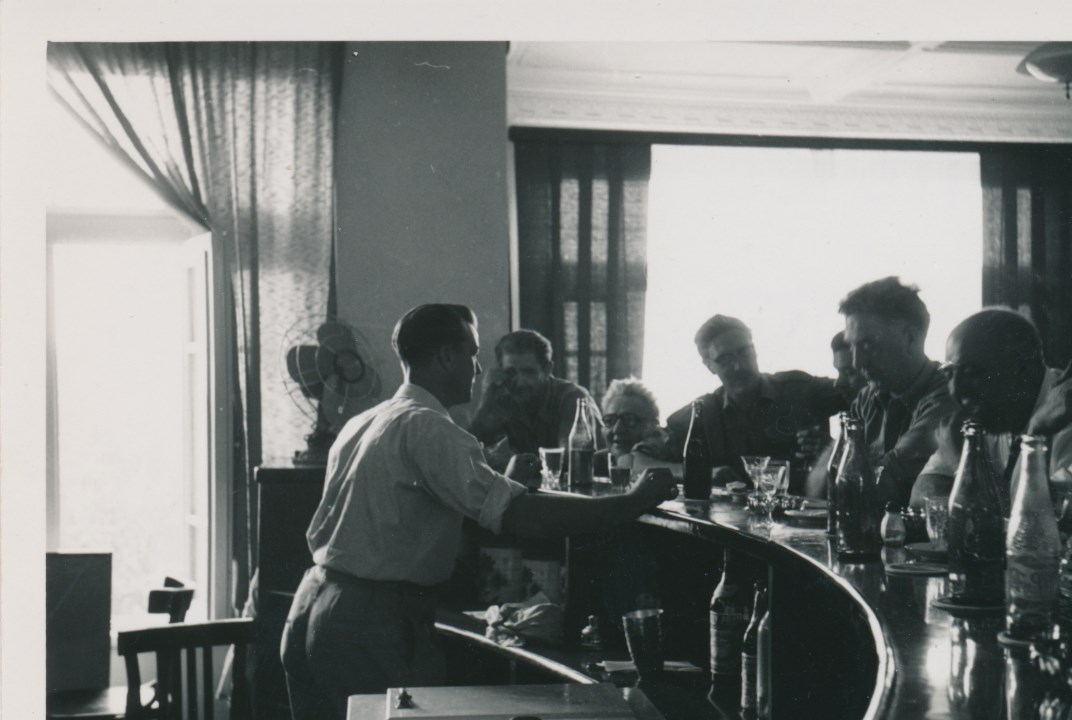
And here he is having a drink with a few others in a hotel bar somewhere in Northern Iran:
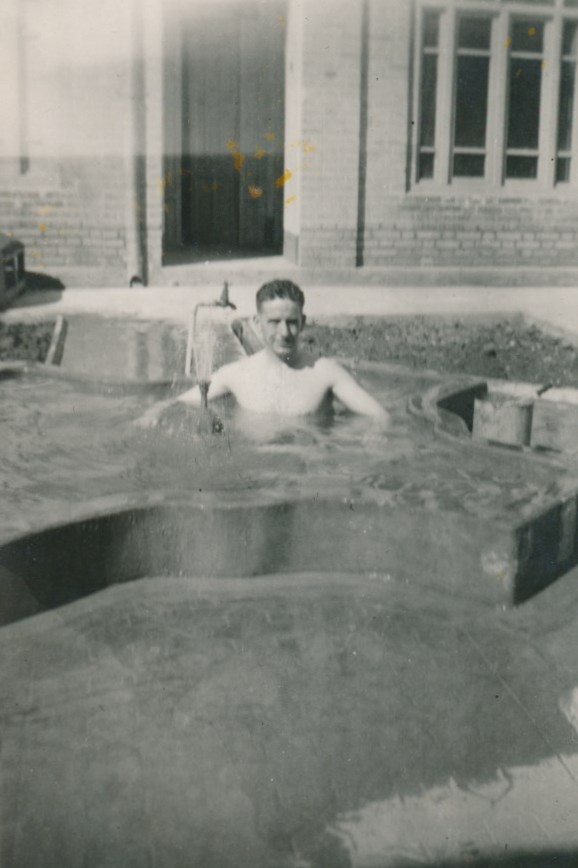
He also found time to relax in the spa a little, too! Who’d have thought a government worker would have had access to such a luxury in the early 1950s?
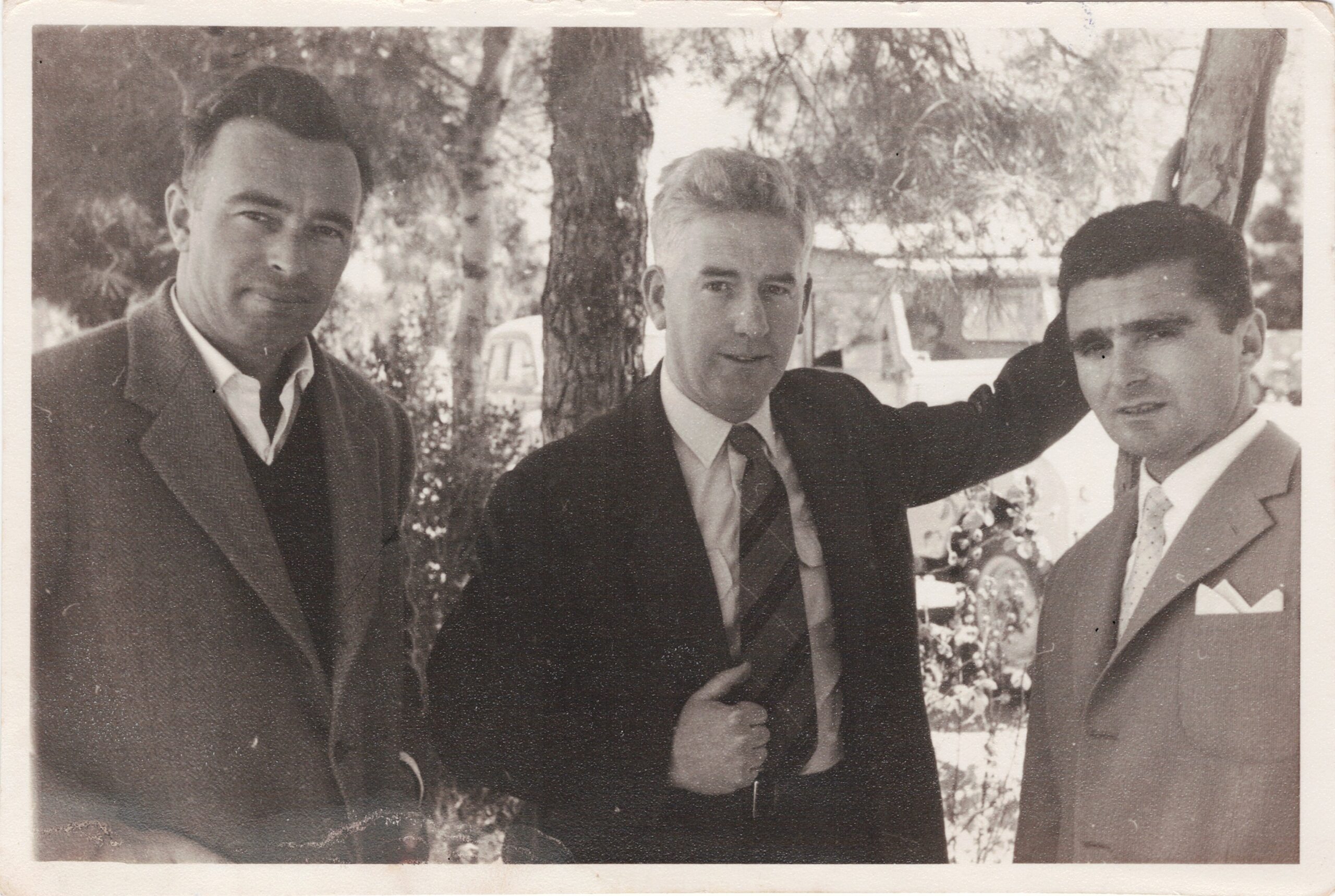
Somewhere along the way Dad spent time in Shiraz. Left-to-right we are looking at Sergio Mora, Dad, and Spartaco Terrazan, all snappily dressed while enjoying the shade of a tree.
Sergio and Spartaco were Italian surveyors of the Shah’s Plan Organisation, according to what Dad’s written on the back of the picture. I often wonder what happened to them, and if they have descendants alive today:
Dad’s assignment was for 18 months, and he served out his time before heading to Australia for his next great adventure. I have several documents regarding his winding up of service in Tehran, but have to admit that I was rather stunned at the caring nature of this letter from the MoW in April, 1951 (signed, I think, by a G.B. Grestock), which contrasts with the kind of ‘officialdom’ I would have expected from letters in those days.
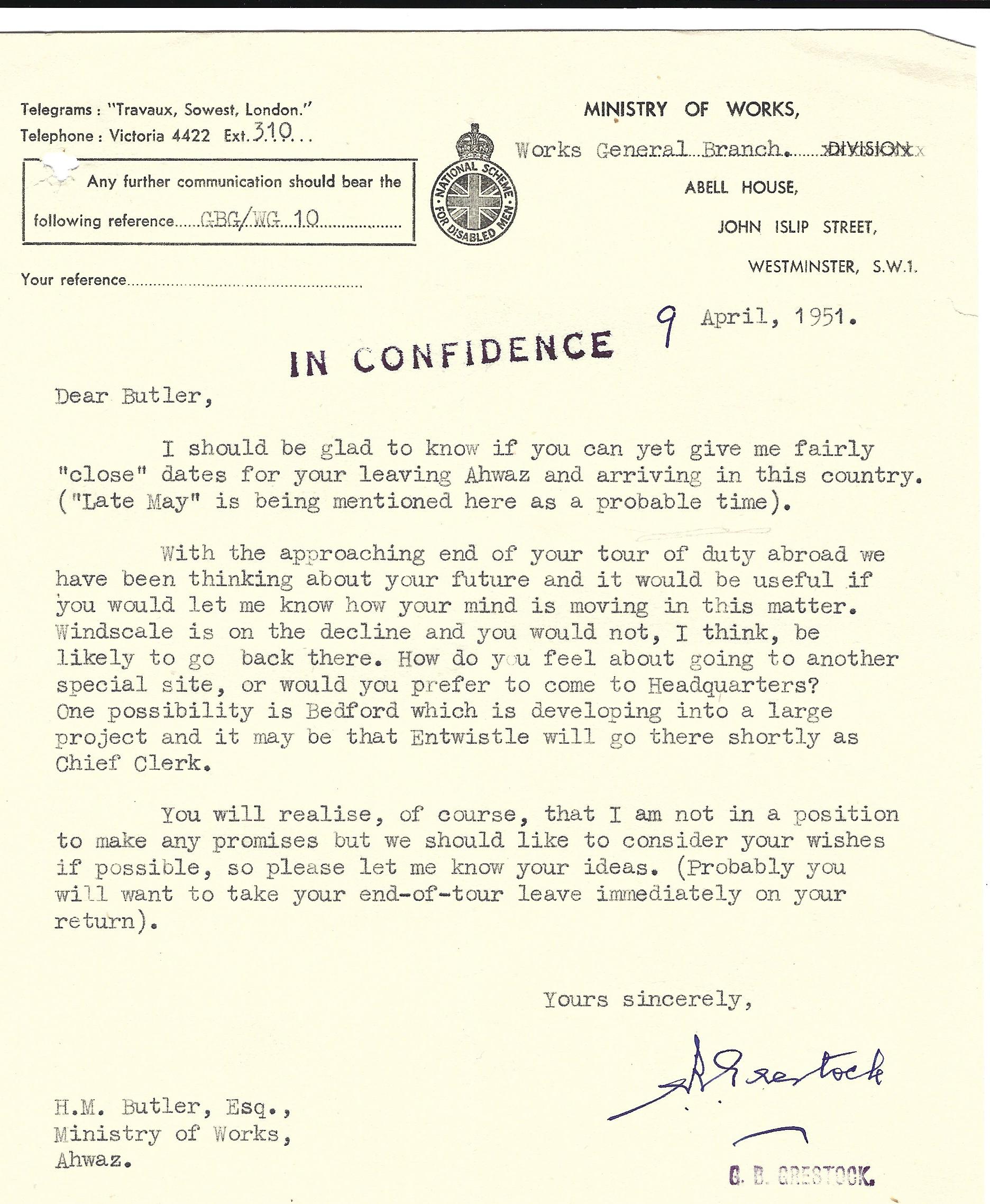
Click here for a transcription of the above letter
What I found interesting about the letter above is that its logo is for the ‘NATIONAL SCHEME FOR DISABLED MEN’, even though it comes from the Ministry of Works. So although that was probably a program designed to help war veterans, it existed 60 years before Australia started the NDIS.
Back to the Future
But what I then found really interesting is that Dad didn’t just go to Iran once, he returned for a second stint after receiving an offer from John Mowlem and Co., Limited dated 15 August 1956 to go there as a Cost Clerk on the Iranian Roads Reconstruction Project:
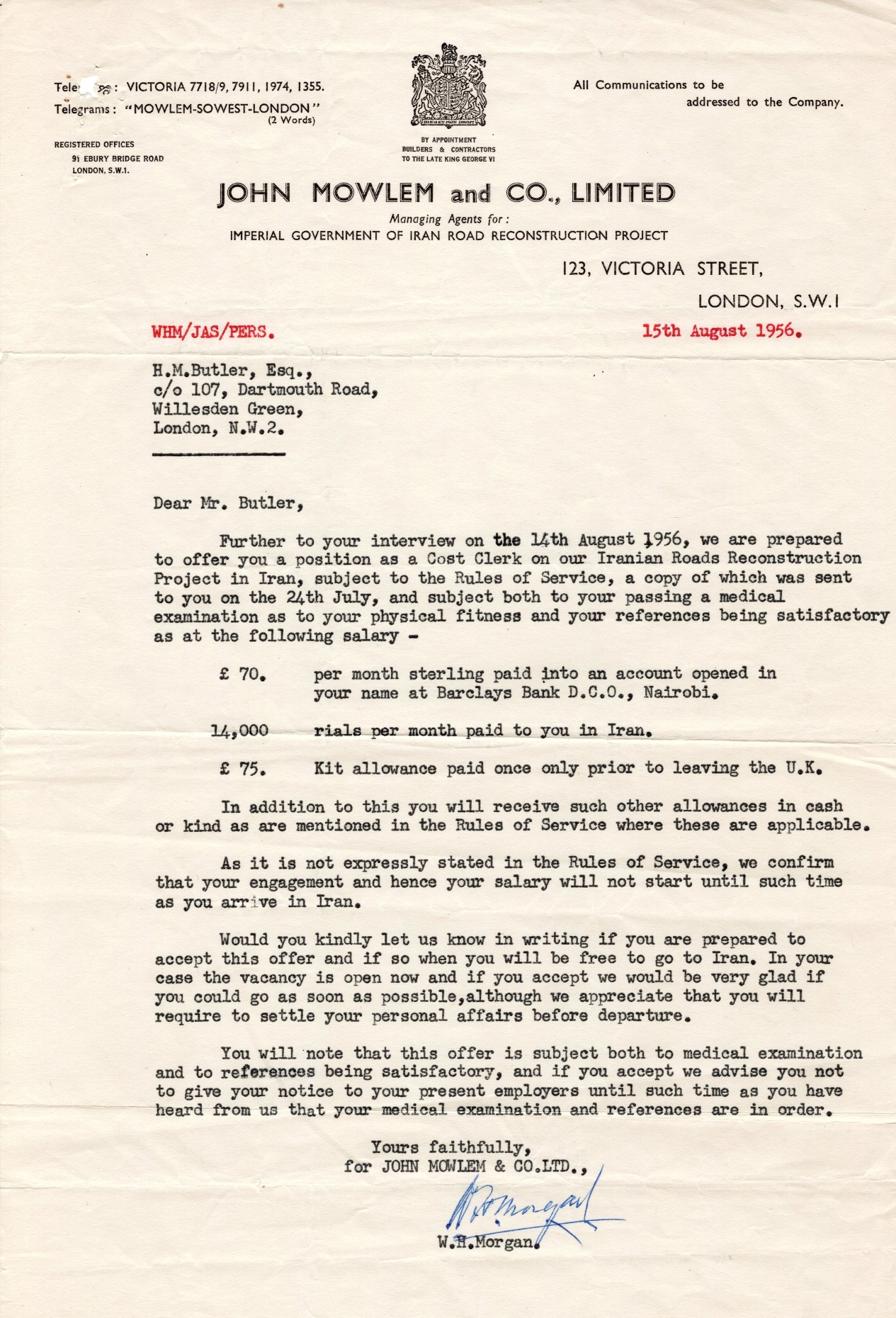
Click here for a transcription of the above letter
Although this appointment, confirmed by letter dated 22 September 1956, was for 18 months, it appears that Dad lasted less than 12 months, based on John Mowlem’s acceptance of his resignation dated 30 July 1957.
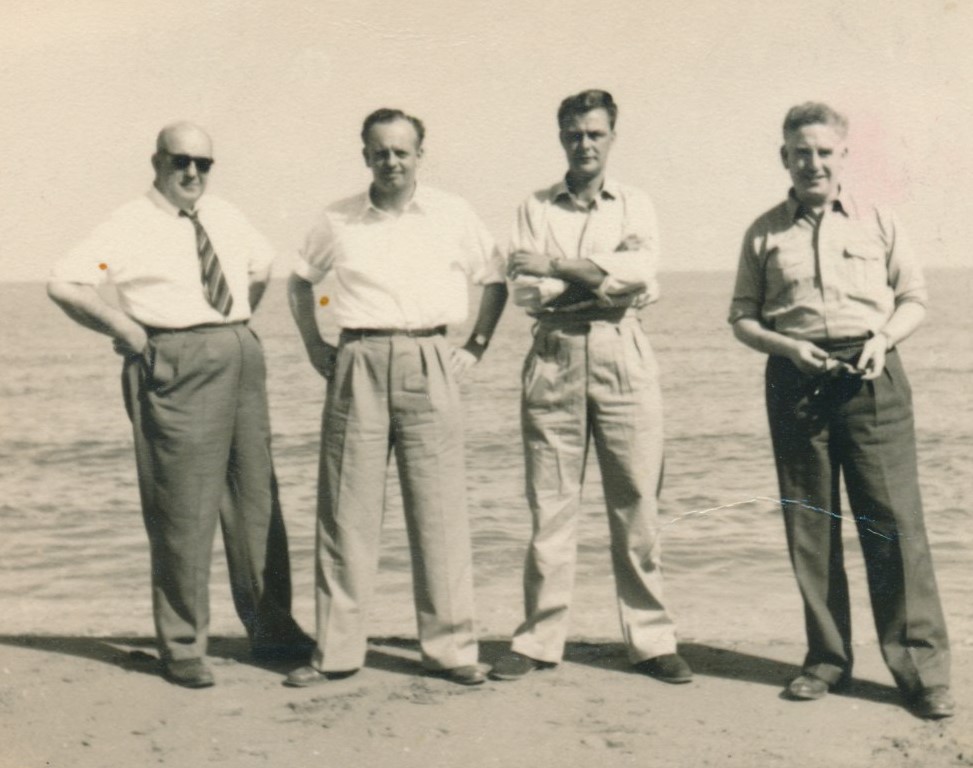
During this stint, though, he still found time to explore more. Here he is in October 1956 on the southern edge of the Caspian Sea with, left-to-right as we look at it, fellows by the name of Bill West, Jim Beattie and Bob O’Malley, with Dad on the far right, a snobby step away! (I suspect those gents’ real names were William West, James Beattie and Robert O’Malley. Now I know where Aussies get their desire to shorten names of everything and everyone – from the Brits! 😉 )
The wrap-up
The photos and documents I have tell me part of the story of this time in Dad’s life, but I was lucky enough to hear some stories first-hand – such as the time he had to smuggle some plans onto a boat and play cards to pay for his passage out. I don’t know how true that story was, but while reviewing all the documents for this blog post, I did notice one document which briefly referred to MI6. But of course I can’t find that now, can I? He did have to sign documents regarding the Official Secrets Act when he left Iran, so maybe he was telling me the truth? I’ll never know now!
But that’s part of exploring our family history, isn’t it? We will already know some things, we will discover others, and then there will always be things we can only ever guess or wonder about.
~
If you’d like any help with finding, recording or writing your family history, please feel free to find out how I can help you here: https://jennifermosher.com.au/dead-rel-hunting/